Robotic degating and grinding

A cast part comes out of the mould with its gates and risers still on. Our cell cuts them off on a circular saw and grinds the cut clean on the belt, while the operator stays outside, away from the blade and the dust.

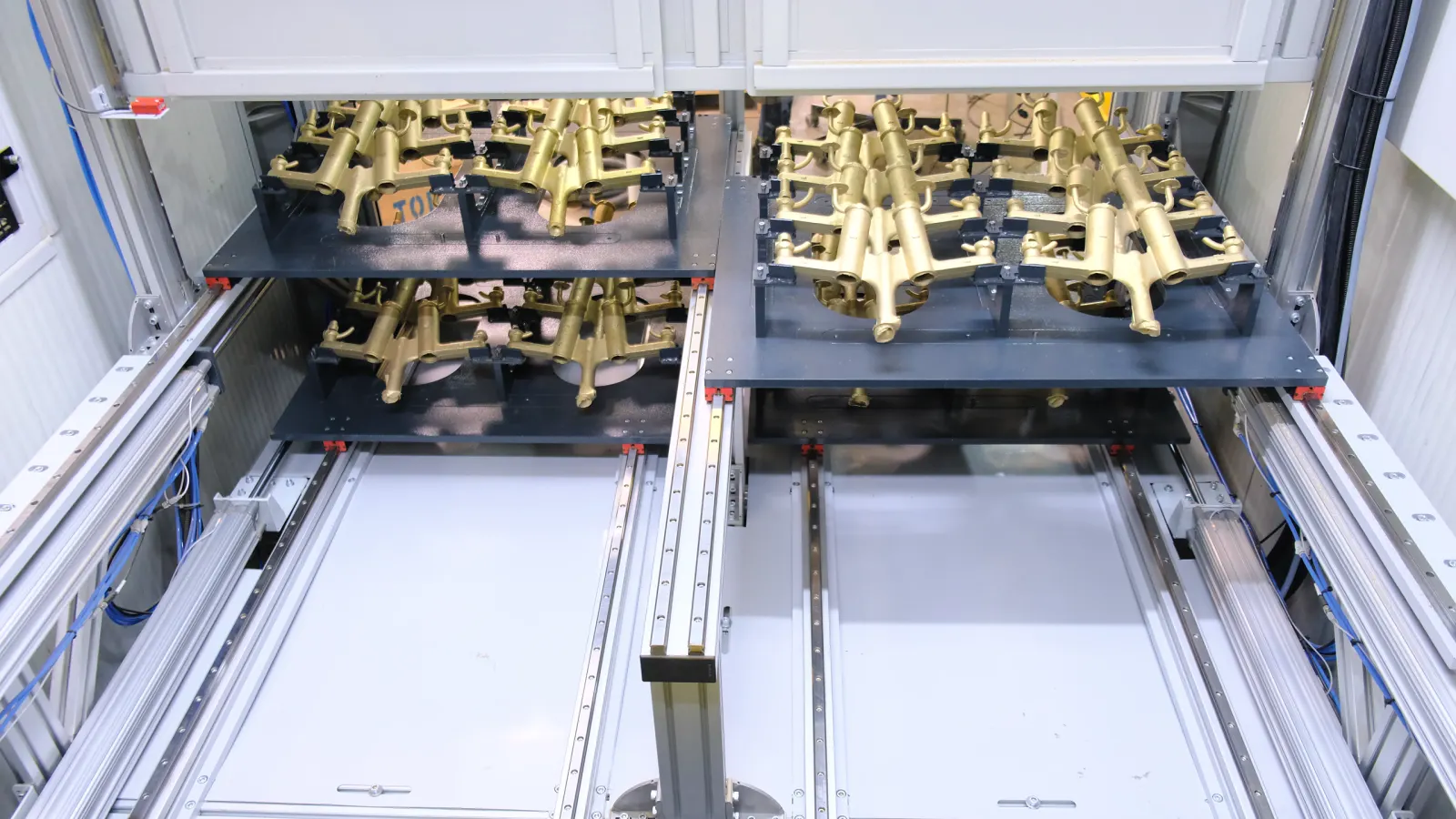
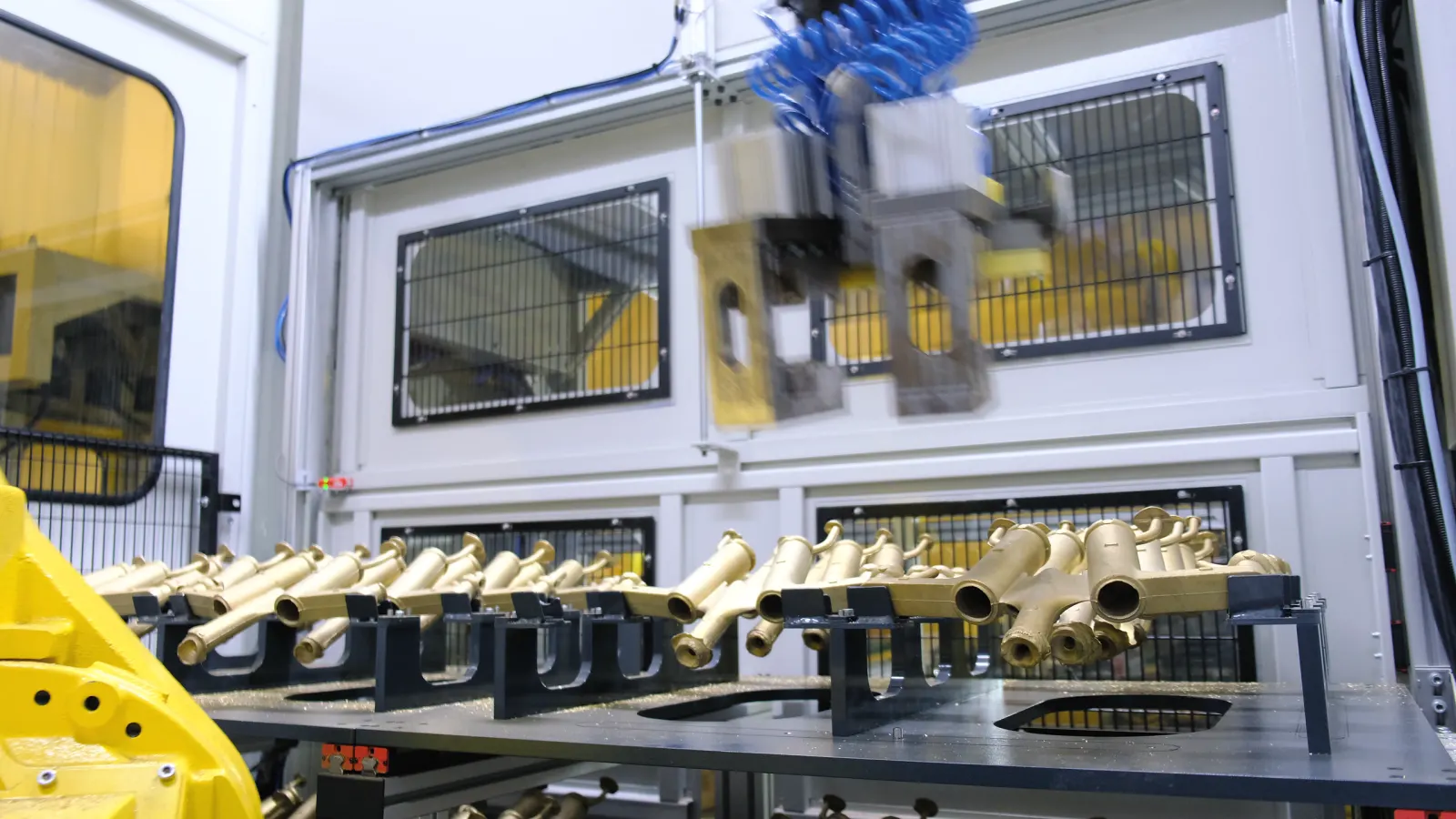
  1. Four drawers of brass tap bodies slide out of the cell, each casting in its own fixture.
    01Fed from the drawers
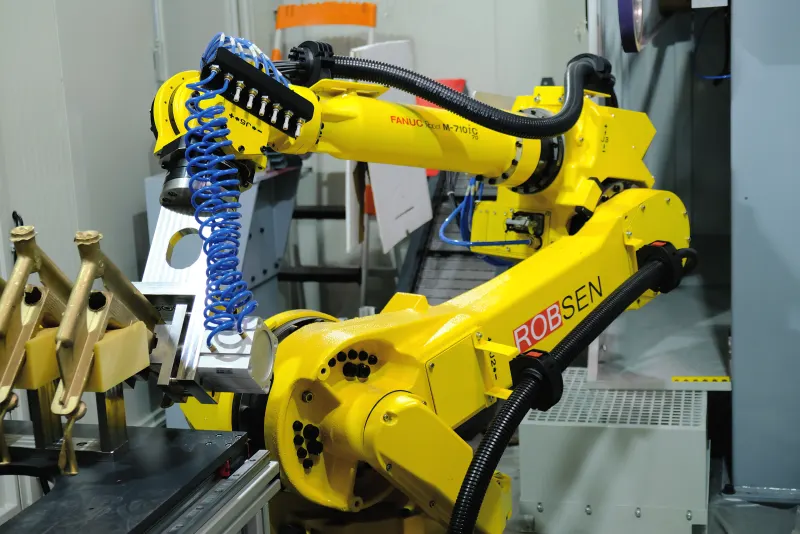
  2. The robot's gripper takes a brass tap body out of its fixture in the drawer.
    02Picked from its fixture
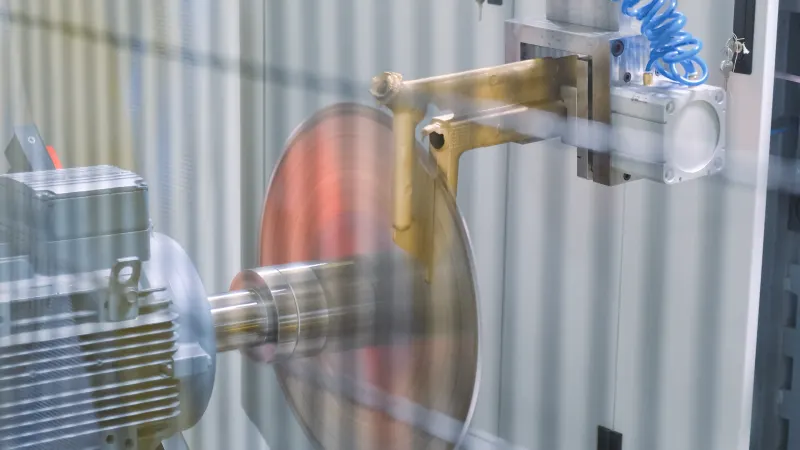
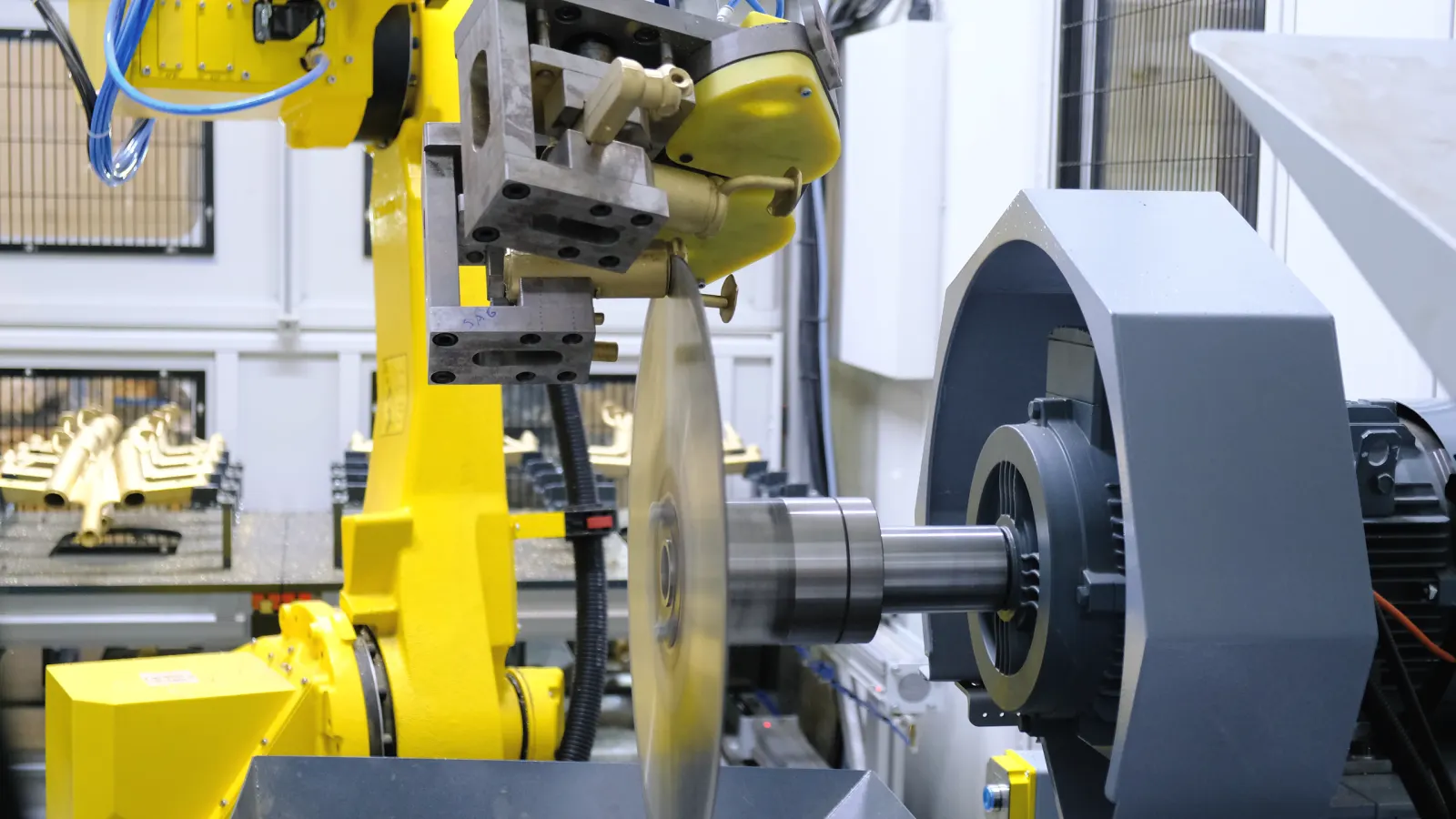
  3. The robot holds the casting against the circular saw; the drawers of castings behind it.
    03Cut at the gate
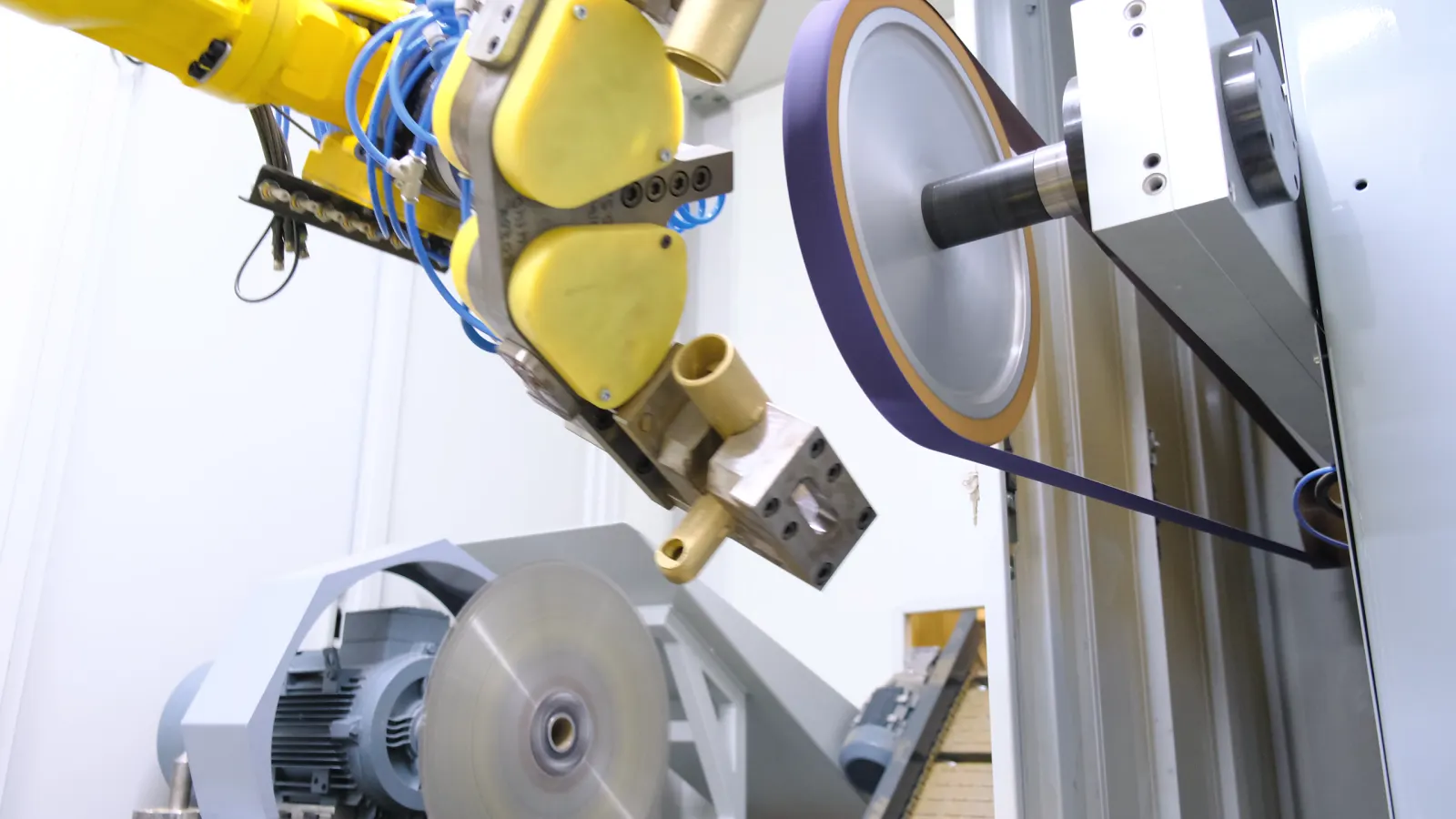
  4. The robot holds the casting against the belt grinder; the circular saw below.
    04Ground on the belt

Let the robot hold the part

Cutting and grinding castings manually is hard, dusty and dangerous work. In this cell, the operator only fills the drawers.

Seen through the cell’s window: the robot holds the casting to the saw.
  1. 01

    Hands away from the saw

    Nobody holds a casting against a spinning blade. The operator fills the drawers outside the cell; the robot does the cutting.

  2. 02

    Dust, noise and vibration stay inside

    The cell is fully enclosed behind reinforced windows. Nobody spends the shift pressing parts against a belt, breathing the dust and feeling the vibration in their hands.

  3. 03

    The same cut on every part

    The robot follows the same path at the same pressure every cycle, so every casting comes out cut and ground the same way.

  4. 04

    Hours on its own

    Four drawers hold enough castings to keep the cell working for up to about three hours without the operator.

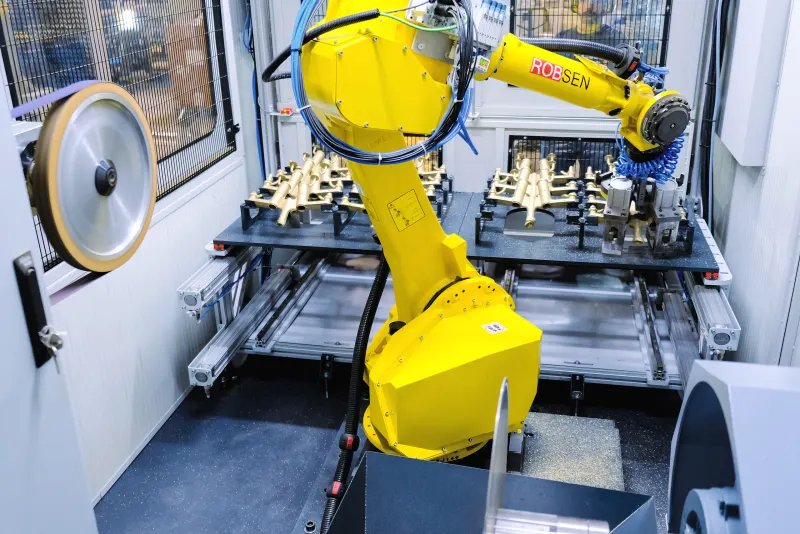
Inside the cell: the FANUC robot, the belt grinder on the left and two drawers of brass tap bodies in their fixtures.
Inside the cell: the robot, the belt grinder and the drawers.

From the drawer to the belt

Degating means cutting the gates and risers, the channels the metal flowed in through, off the casting.

  1. 01

    Fill the drawers

    The operator sets the castings in their fixtures and slides the drawer into the cell. There are four drawers.

  2. 02

    Pick

    The robot takes a casting out of its fixture.

  3. 03

    Cut

    It holds the casting against the circular saw, which cuts the gate and the risers off close to the part.

  4. 04

    Grind

    On the belt it grinds the cut smooth. A regrip station lets it turn the casting to reach the next face.

  5. 05

    Next

    The finished casting is set down and the robot takes the next one.

A belt head that gives way

Castings are never quite alike. One has 3 mm of gate left to grind, the next 6 mm. Taken the same way, the thicker one would load the belt until it tears.

So the belt head is compensated. When the force rises, the contact wheel gives way and moves back: the belt keeps grinding at an even pressure, and the belt, the casting and the robot are spared.

Grinding the cut on the compensated belt head.

One unit, fully enclosed

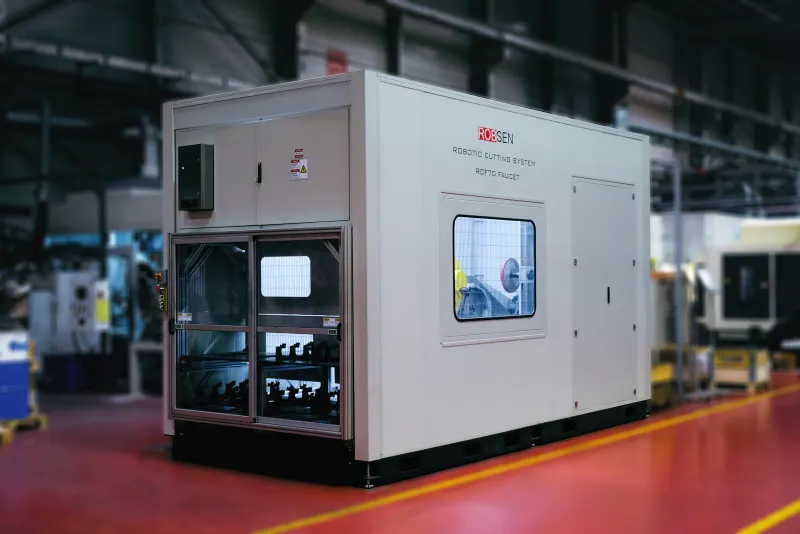
Robot, saw, belt, drawers and controls are built on one base and leave our plant as one piece. Set it down where the castings are, connect it, and it runs.

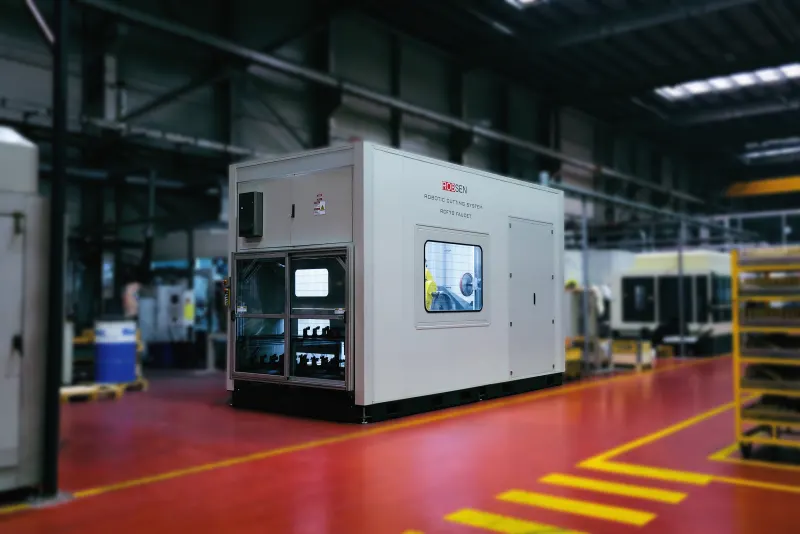
The closed cutting cell in a production hall: white walls, a reinforced window, the drawer doors at the front. 2,300 mm4,800 mm2,700 mm
The cell on its single base: 4,800 × 2,300 mm, 2,700 mm high.
  1. 01

    Fully enclosed

    Walls all round and reinforced windows to watch through. The saw, the chips and the dust stay inside, and so does most of the noise.

  2. 02

    One base, plug and play

    Everything the cell needs sits on its own base, so it moves as one piece and starts working soon after it is set down.

  3. 03

    Doors where the work is

    The drawers slide out at the front to be filled outside the cell; the rest of the cell stays closed while it runs.

From our plant to yours, in one piece

Air, power and one dust outlet: at our customer we provided the outlet and the plant’s filter line was connected to it. Undo those and the cell is free to move. It goes on one truck and starts working soon after it is set down.

At Robsen, Gebze
  1. Tested at RobsenThe cell runs your part in our workshop while our engineers go down the checklist.
  2. Stopped and unpluggedThe robot goes home, then the air hose, the power cable and the dust duct come off. The lights inside go out with the power.
  3. Out of the workshop, onto the truckA forklift lifts the whole cell by its base and sets it on a curtain-side trailer.
  4. On the roadOne truck carries the cell to your plant.
  5. Into your plantA forklift takes it off the trailer and puts it where it will work.
  6. Connected, fed and runningPower back on, and the lights come on with it. Air on, parts in the drawers, start: the tower turns green and the robot works.
Fitting the fixtures for a longer part.

Another part, another set of fixtures

Each casting has its own fixtures in the drawers and its own program in the robot. Changing over means fitting the new fixtures and selecting the program.

Gallery

The film and photos of a cutting cell we built for brass tap bodies, in production.

RCF70 robotic cutting cell for faucetsWatch on YouTube

The cell in brief

Application
Degating and grinding of castings
Solution
Surface Finishing
Parts
Brass tap bodies and similar castings
Robot
FANUC M-710iC
Cutting
Circular saw
Grinding
Belt grinder with a compensated head
Loading
Four drawers, up to about 3 h on its own
Enclosure
Fully enclosed, reinforced windows
Footprint
4,800 × 2,300 mm, 2,700 mm high, one unit

Next: grinding and polishing

Zamak parts sanded and polished, loaded from outside the cell.

Then: machine tending with IROCUBE

The finished casting goes on to the machining center.

Questions we are asked

Which castings can the cell take?

It was built for brass tap bodies. Castings of a similar size and shape can follow the same path. Send us a part and its drawing, and we will tell you how it would be held, cut and ground.

What if one casting has more to grind than the next?

The belt head is compensated. When there is more metal to take off and the force rises, the contact wheel gives way, so the belt does not tear and the robot and the part are not strained.

Why a circular saw?

A circular saw cuts close to the part and leaves a clean face, so there is less left for the belt, and its blade lasts a long time. The robot brings the casting to the blade along the same path every time.

How long does it run without the operator?

With its four drawers full, up to about three hours, depending on the part.

How fast is it?

The cycle depends on the casting: how many gates and risers it has and how much is left to grind. Send us your part and we will tell you the cycle for it.

How do we change over to another part?

Fit the part’s fixtures in the drawers and select its program. Each casting has its own set of both.

Is it safe to work next to?

The cell is fully enclosed and the operator works only at the drawers, outside. The blade, the belt and the robot are behind walls and reinforced windows.

Send us your casting

Every cell starts with the part: where its gates and risers are, how much is left to grind, and how many types you run. Send us a casting and its drawing, and we will set up the right cell with you.

Talk to an engineer