
Service
We design a robotic cell to run for 15 years, 20 with good maintenance, and the first one we built, in 2014, is still in production. Most of its life is after the handover, so most of our relationship with you is service: the training before the cell leaves our plant, the remote access when something stops, the spare part on the shelf, the engineer on the plane.
What service means here
Designed for uptime, supported for the long run. Six parts of it, from the first training day on.
- 01
Training, during the FAT, by role
Your operators, maintenance staff, engineers and managers are trained while the cell is still at our plant, each in what they will need: running and programming the robot, the gripper and the fixtures, maintenance, the IROVISION modules, and simulation workshops for the engineers. Teaching the cell a new part is part of it.
- 02
Secure remote access
A secure VPN into the cell. Many questions are answered without a visit, and System Manager shows the cause of a stop the moment it happens, so the call starts with the fault, not with a search for it.
- 03
Critical spare parts, planned with you
The list of parts that can stop the cell is written at handover, and we plan with you which of them to keep on the shelf. The measure of agility is downtime, not the price of the part.
- 04
Preventive maintenance
Planned visits, with the life of every component tracked in System Manager, so a wearing part is changed on a planned day rather than on the day it fails.
- 05
Engineers on site
When a problem needs hands, ours come. Our cells run in Türkiye, Germany, Italy, the Czech Republic, Slovenia and Greece; in North America there is Robsen Robotics USA in Shelby Township, Michigan. Before we invoice a service call, we check whether the request comes from something we left out of the quote.
- 06
Service plans
Preventive, intervention or full coverage, agreed per cell. Ask us for the one that fits how your line runs.
The cell tells you first
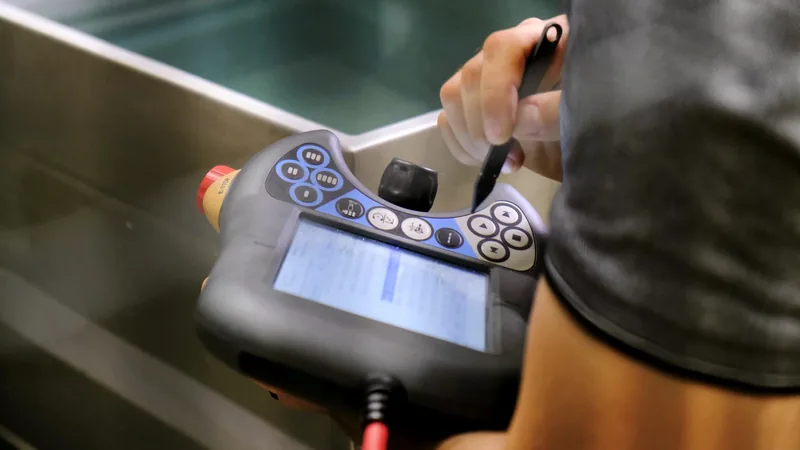
System Manager, our own web-based screen, is how a cell reports on itself: live status, OK and NOK counts, cycle time and OEE, the cause of a stop as it happens, the life of every component and an event log, on the cell's touchscreen, a tablet or a phone. It is what our service engineer looks at too, so you and we see the same thing.
Built to last, and to move
15 years, 20 with care
That is the horizon we design, test and keep spares for. Our first cell, built in 2014 to feed a transfer machine at Torun Metal, is still in production, and we still service every cell we have built. We run the acceptance test ourselves before your team sees the cell, because a cell that passes a hard FAT has an easy life.
Moved, not scrapped
IROCUBEs we installed ten years ago have moved several times within the same plant and were running again the same day. A T series cell we commissioned at a Doosan lathe seven years ago is still in production every shift.
Owned by your team
The goal of the training is a team that owns the cell: that teaches it a new part, clears a stop and knows when to call. The screens are simple on purpose, and operators learn them in under an hour.
- Also in Long term
- R&D
- All nine
- How we work: the nine capabilities and the loop they form
Service for an installed system?
Tell us the cell and what happened. Remote support, a spare part or an engineer on site: an engineer who knows the cell answers.
Contact service