
EQUALIZER straightening machine
A casting can come out of the die a few tenths of a millimetre out of shape. Our EQUALIZER measures it with lasers, presses each arm only as far as it needs, and measures it again until the part is in tolerance. We built it for the drum spider of a washing machine. It works with an operator, or in a line with robots.
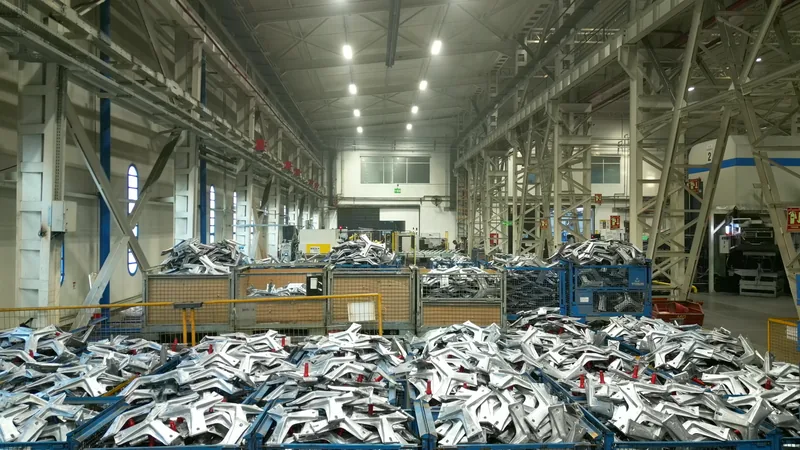
01Cast by the thousand 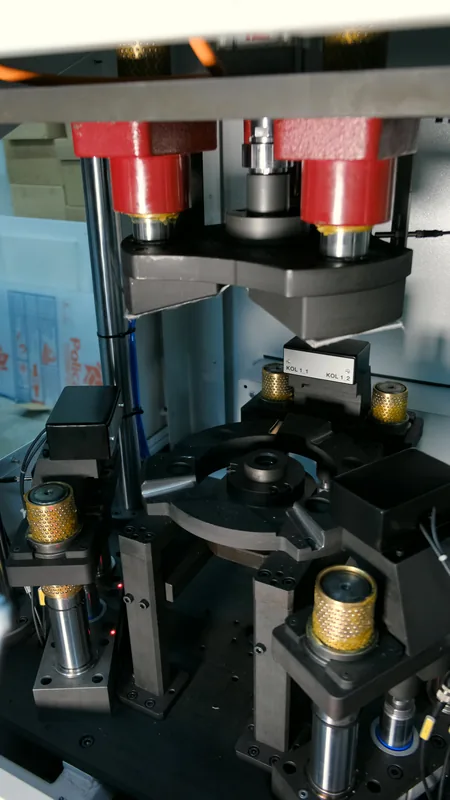
02Into the fixture 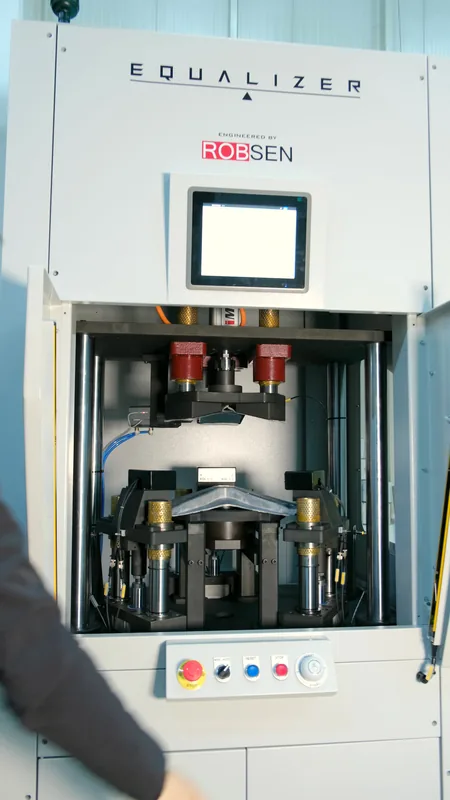
03Measured and straightened 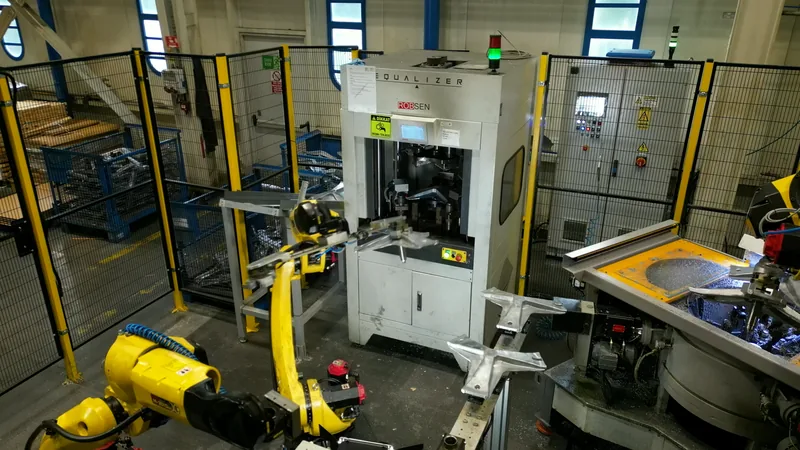
04Or in a robot line
Why a casting comes out bent
Aluminium shrinks as it cools, and a casting never cools evenly. The stresses that leave behind pull the part out of shape, and every part a little differently.
- 01
Uneven cooling
A thick hub cools later than thin arms. The part shrinks unevenly and pulls itself out of shape.
- 02
Out of the die, into water
The part is pushed out of the die while it is still hot and soft. Die casters who ask us for a straightening machine usually cool it in temperature-controlled water tanks, where the heat leaves it fast.
- 03
Gates and overflows cut off
Trimming releases the stresses that were held in the gates and overflows, and the part moves again.
- 04
No two alike
Each casting bends its own way. No fixed press stroke corrects them all: each part has to be measured.
A few tenths at the drum
The spider holds a washing machine’s drum on its shaft, bolted to the drum at the end of each arm. If the arm ends are not in one plane, the drum sits crooked on its shaft. Nobody sees it on the part. At spin speed the whole machine feels it: the drum wobbles, the cabinet shakes, and the bearings take the load.
Manually, it is trial and error
Without a machine, an operator measures the part with a gauge, presses it in a hand press and measures it again. The casting springs back by a different amount every time, so the result depends on the person and the shift.
| Manually | With the EQUALIZER | |
|---|---|---|
| Measuring | A gauge, one point at a time, the part taken out | Six lasers at once, two on each arm, the part in its fixture |
| How far to press | As far as the operator judges | Calculated for each arm from its readings, past the line by the springback |
| Springback | Found out afterwards, and pressed again by feel | Measured again at once; pressed again only if needed |
| The result | Depends on the person and the shift | The same tolerance on every part |
| A record | None, or a tick on a sheet | Every part’s readings and its OK or not OK on the machine |
| The operator | At the press all shift, one part after another | Loads the fixture, or only feeds a conveyor |
Measure, press, measure again
The EQUALIZER repeats it until every point is in tolerance, then shows the result on its screen. In the drawing, the first part needs a second press on one arm; the second part is done in one.
On the machine, step by step
Hover over a step to watch it.
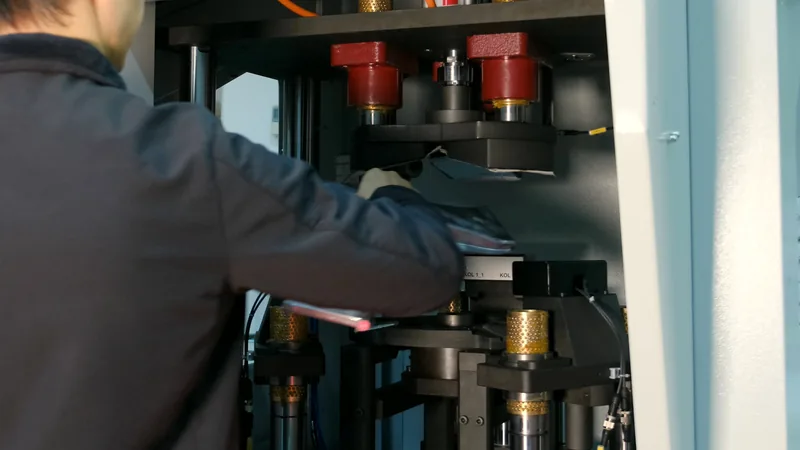
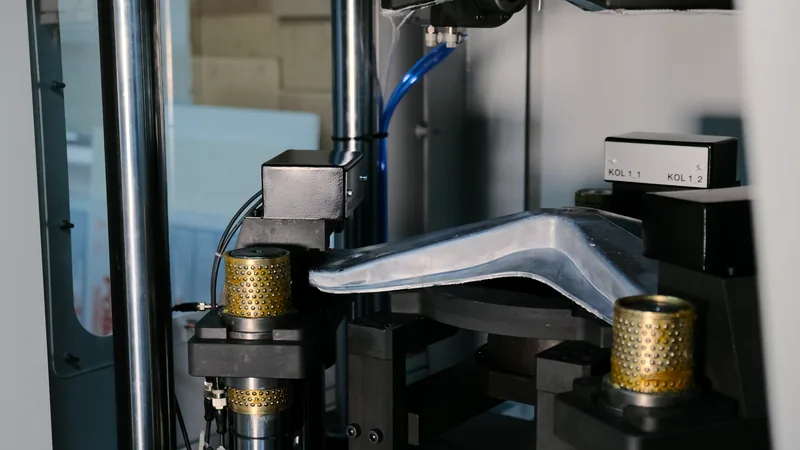
01LoadedThe operator sets the spider into the fixture and starts the cycle. The fixture holds it in place. 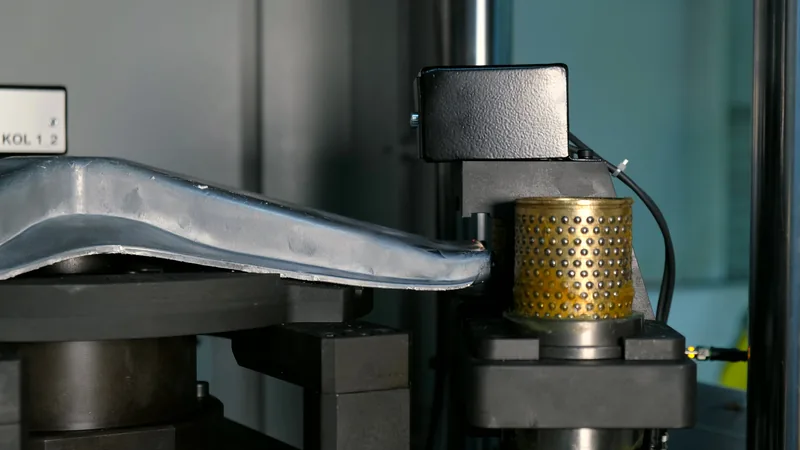
02Measured at six pointsTwo lasers over each arm measure its height. The software compares every point with its target. 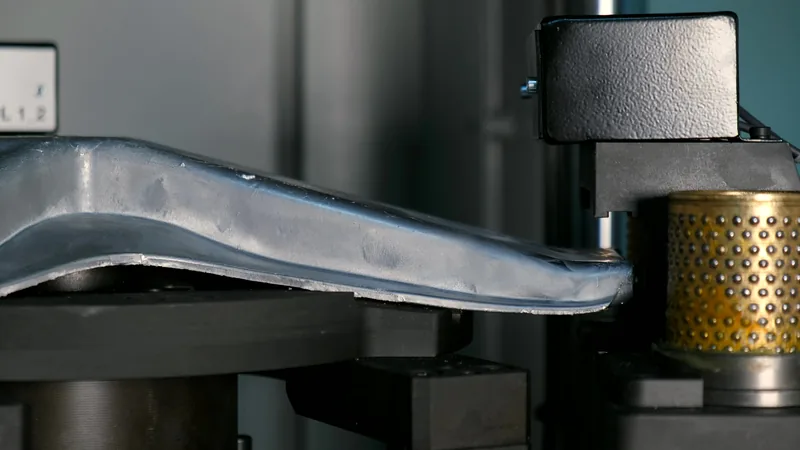 Real speed
03Pressed where it is bentEach arm has its own straightening axis. It presses its arm only as far as the readings call for, a little past the line, because the casting springs back. 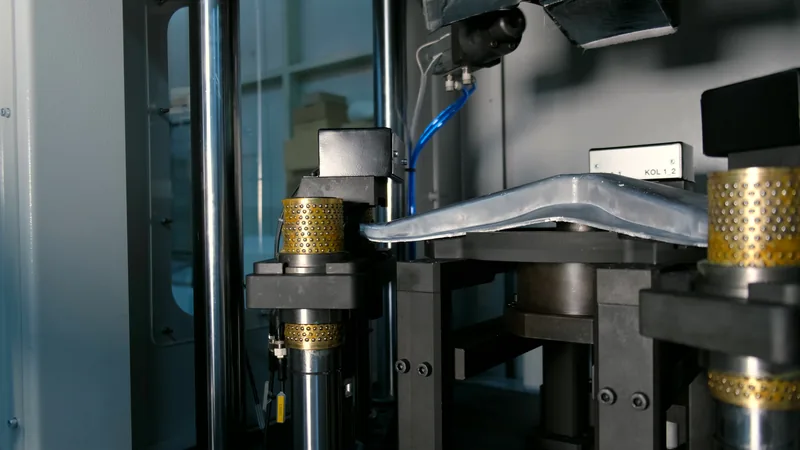 Real speed
04Held, released, measured againThe lasers read the part again. An arm still out of tolerance is pressed again, with a smaller stroke. 
05OK or not OKWhen every point is in tolerance, the screen says PART IS OK. The readings of every part stay on the machine. 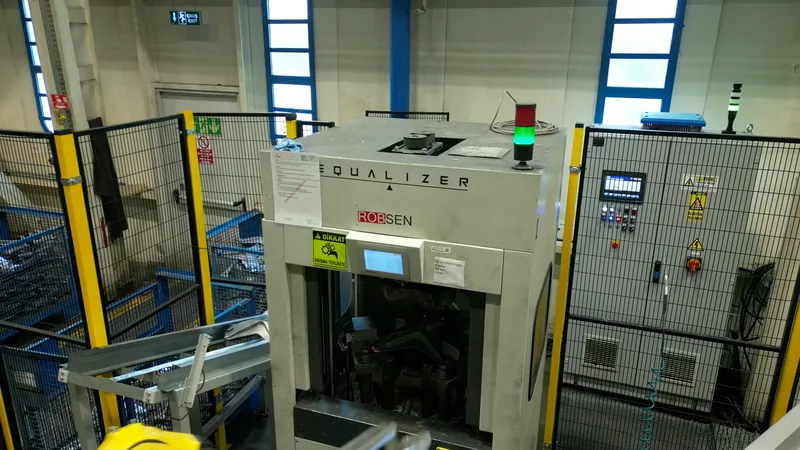 Real speed
06Or loaded by a robotIn a line, a robot sets the part in and takes it out. The machine works the same way.
Steps 01 to 05 were filmed at our plant during testing. Step 06 is from the robot line at our customer’s plant.
Inside the EQUALIZER
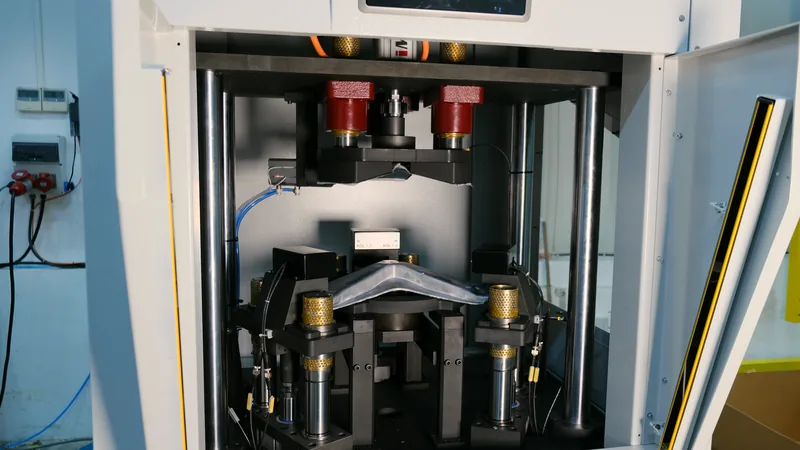
A compact machine on one frame, built around the part it straightens.
- 01
One straightening axis per arm
Three axes, so each arm gets its own stroke. Servo-electric with ball screws, or hydraulic.
- 02
A positioning axis
A fourth axis brings the part to the same place for every measurement.
- 03
Six laser distance sensors
Two over each arm. They read the part in the fixture, so it never has to be taken out to be measured.
- 04
Our own software
System Manager on a touch screen: the cycle, alarms, the readings of the last parts, and a recipe for each part.
- 05
Safe at the opening
A light curtain guards the front, and a signal tower on top shows the machine’s state from across the hall.
- 06
A fixture for each variant
The fixture is made for your part. A new variant gets its own fixture and its own recipe.
Two EQUALIZERs, six robots
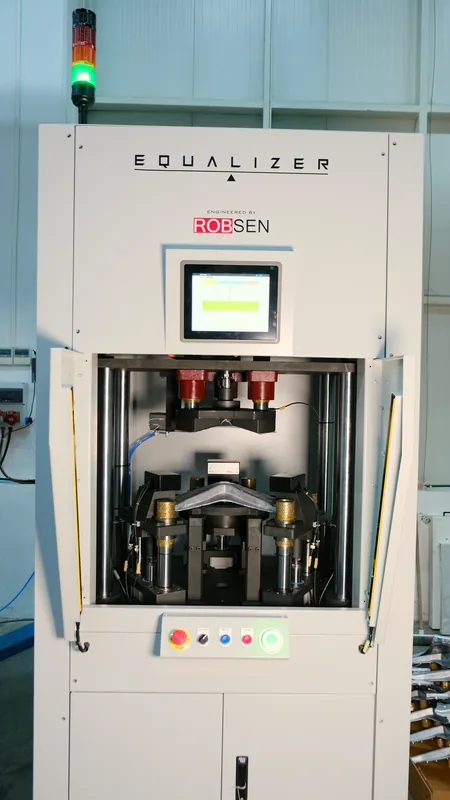
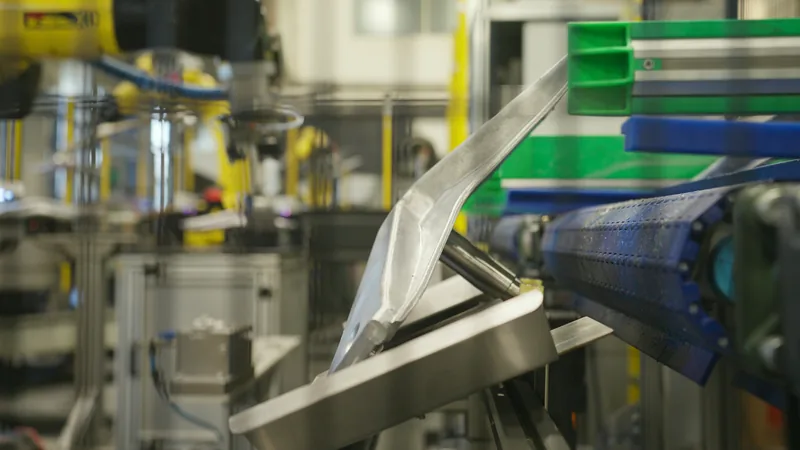
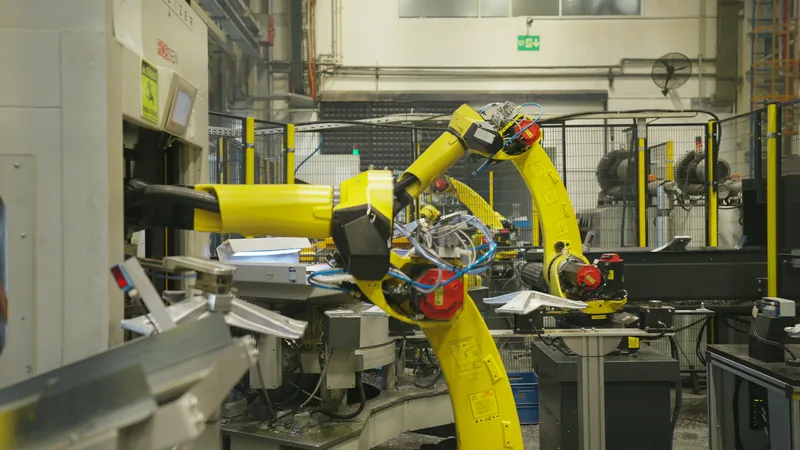
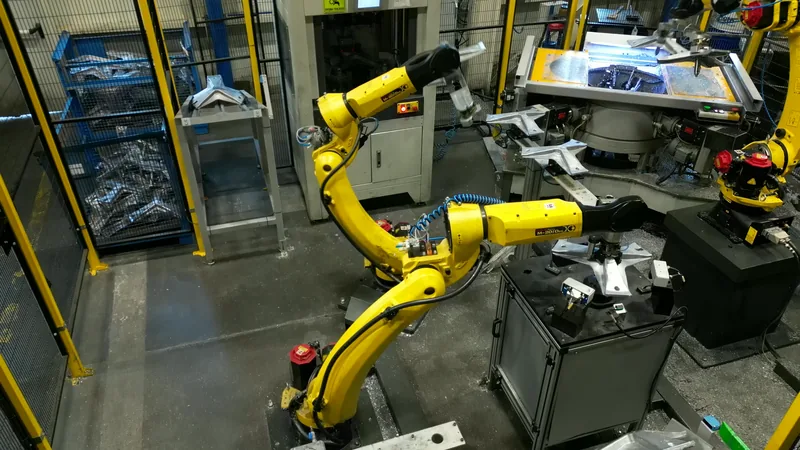
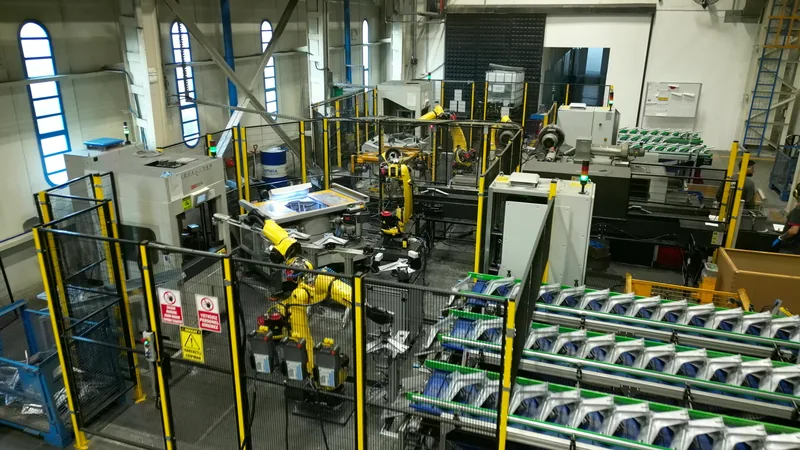
At a die caster’s plant, two servo-electric EQUALIZERs work in a line with six FANUC robots. Operators feed the castings to the conveyors. The robots take each spider from there, load the machines and unload them.
- Straightening machines
- 2
- Robots
- 6
- Laser points a part
- 6
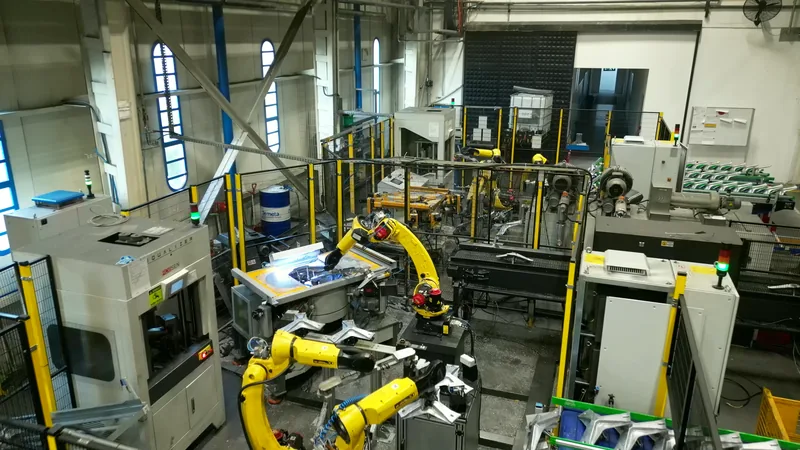
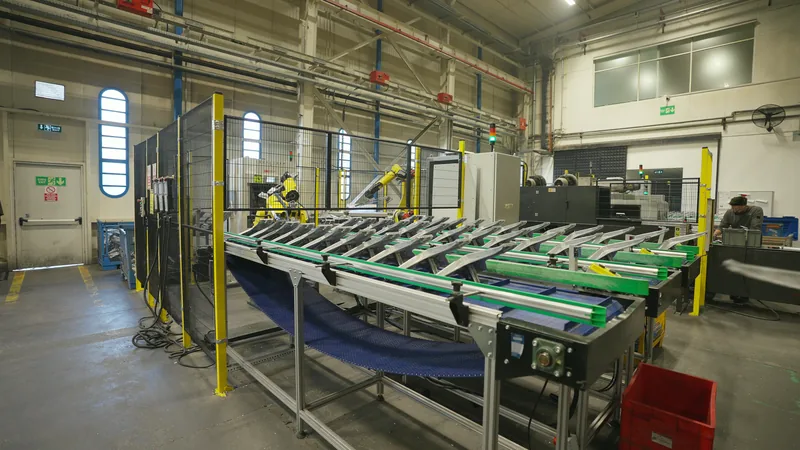
The line, from the bin to the machine
The conveyors hold a buffer of castings, so the machines keep working while the operator brings the next bin. Nobody holds a part at a press.
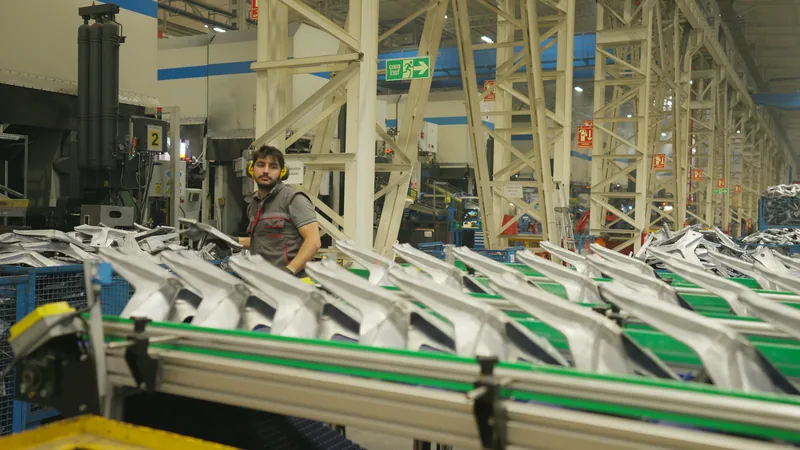
When no catalogue machine does the job
Some jobs fit no standard machine: a part only your plant makes, a tolerance only your customer asks for. Then we design and build the machine ourselves, the way we build our robotic cells. The EQUALIZER is one of them.
- 01
One team for the whole machine
Mechanical, electrical, software and automation engineers work on it together, under one roof.
- 02
Designed around your part
We start from your samples, your drawing and your tolerance. The fixture is made for your part.
- 03
Built and tested at our plant
We build and wire the machine, and run it with your parts before it ships.
- 04
Commissioned at yours
We set it up in your plant, train your operators and hand over the documentation.
- 05
Ready for robots
The same machine works with an operator today and in a robot line later.
The EQUALIZER in brief
- Machine
- EQUALIZER straightening machine
- Solution
- Special Machines
- Part
- Die-cast aluminium drum spider of a washing machine
- Measurement
- Six laser distance sensors, two on each arm
- Straightening
- Three axes, one per arm: servo-electric with ball screws, or hydraulic
- Positioning
- One axis for the part
- Control
- Touch screen PC, System Manager
- Result
- OK or not OK for every part, readings kept
- Safety
- Light curtain at the opening, signal tower
- Variants
- A fixture and a recipe for each
- Loading
- By an operator, or by robots in a line: two EQUALIZERs with six FANUC robots at a die caster
- Delivery
- One piece; tested at our plant with your parts, commissioned and trained at yours
Questions we are asked
Which parts can the EQUALIZER straighten?
We built it for die-cast aluminium drum spiders: three arms around a hub. The principle, measuring the part in its fixture and pressing it where it is bent, works for other cast or forged parts too, with their own fixture, measuring points and axes.
Send us your part and its drawing, and we will tell you what the machine for it looks like.
What tolerance can it reach?
It depends on the part. Straightening is bending, not machining: the arm is pressed a little past the line and springs back. How close a part can come depends on its thickness, the strength of the alloy and the axis that has to be straightened.
So we set the tolerance with you for each part, from your samples. The machine then presses and measures again until every point is inside it.
Why not press every part with the same stroke?
Because every casting is bent differently, and springs back differently. A fixed stroke straightens some parts and bends others the wrong way. The EQUALIZER measures first and calculates a stroke for each arm of each part.
Hydraulic or servo?
Both are possible. The two EQUALIZERs in the robot line are servo-electric: their ball screws need no oil and set the stroke very precisely. Hydraulic axes give a lot of force in a small space. We choose with you, from the part and the force it needs.
What happens to a part that stays out of tolerance?
The machine shows it as not OK, so it can be kept apart from the good parts. Its readings stay on the machine with all the others.
Can it work in a robot line?
Yes. At a die caster’s plant two EQUALIZERs work with six FANUC robots. The robots load and unload the machines; the operators only feed the conveyors.
Do you test the machine before it ships?
Yes. We build it at our plant and run it with your sample parts. Your team can come to the factory acceptance test and see your own parts straightened.
Send us your part and its tolerance
Every special machine starts with a part that no standard machine handles well. Send us samples and the drawing, and we will work out the machine with you.
Talk to an engineer