Software Development
95% of our projects are vision-guided, and the software behind the camera is ours. So are the cell’s screen, the PLC program and the robot program. When your part changes, the people who wrote the code are the people you call.
Three programs we write
And the PLC and robot programs of every cell, by the same team.
- 01
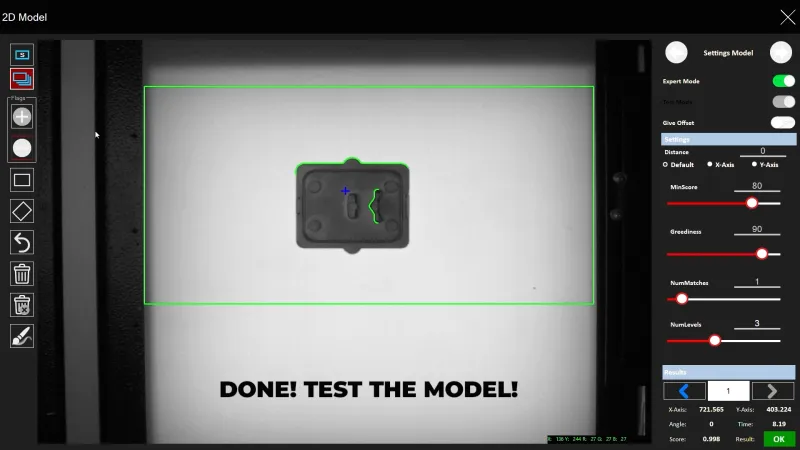
IROVISION
Our vision software for machine tending and quality control, developed since 2014 and built on the HALCON machine vision libraries. Its matching module finds a part of any geometry, in any orientation, on the belt and gives the robot the pick position; a new part is taught once, from a sample or from CAD. Its quality module measures, inspects surfaces, checks threads and reads codes. It has processed more than 500 million parts.
- 02
System Manager
One web-based screen for the whole cell: live status, output, OK and NOK counts, cycle time and OEE, the cause of a stop the moment it happens, the life of every component and an event log. On the cell’s touchscreen, a tablet or a phone, in several languages.
- 03
FleetBridge
Task management for a fleet of mobile cobots: which robot takes which job, the routes, the priorities, and the hand-over when a robot is charging, paused or in maintenance.
Why we write it ourselves
Not for its own sake. Four reasons, and one limit.
- 01
Changes are ours to make
A vision program bought in is a black box the day your part changes. Ours is changed by the engineer who wrote it, often remotely, and a new part is a new model on the screen rather than a new fixture in the workshop.
- 02
One phone number
When the camera software, the PLC program and the electrics come from three suppliers, a stop at two in the morning has three phone numbers. In our cells they have one, and the person who answers can read all three.
- 03
The data is yours
A cell that measures every part can keep what it measured. The valve machine below writes one line per valve: two torques, a test angle, a leak result, a serial code and a time. It is on the machine, ready to export.
- 04
Learned in under an hour
We keep the screens simple on purpose. On the transfer machine cell at KAS Group, more than 20 parts run with no fixtures, a changeover is choosing the model and feeding the parts, and operators learn the screen in less than an hour.
- 05
And we don’t rewrite what exists
IROVISION is built on HALCON, not on our own image processing from scratch. The robot controller stays the robot maker’s. And where a camera is the wrong tool, we say so: at the die casting machine we chose a plate of sensors over a camera, because fog and release agent would have blinded it.
On the shop floor
The software as it looks in three cells that are in production.
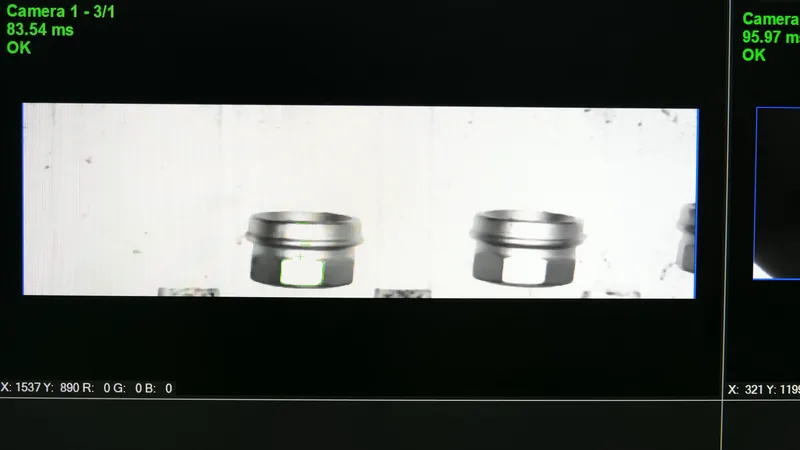
Two cameras, one part
The first camera finds every part on the backlit belt, however it lies, in about 83 ms an image. The second measures its angle in the gripper and sends the correction to the robot.
Transfer machines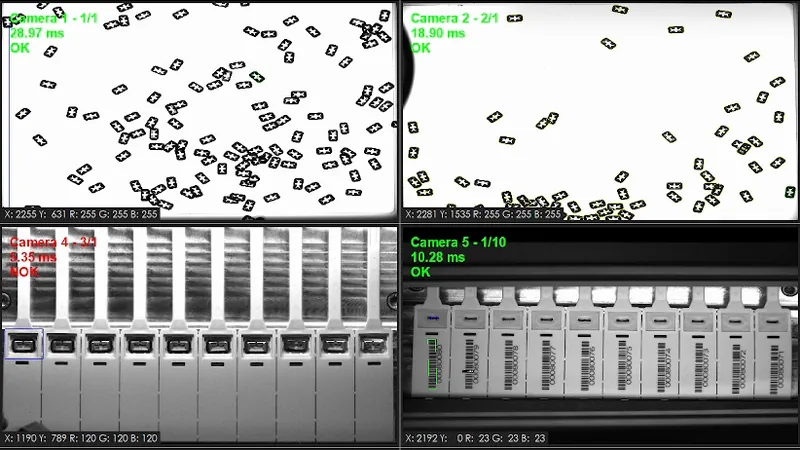
Five cameras, OK or NOK
In the safety seal machine IROVISION decides at every station: which clip to pick, whether five of them sit in the body, whether the barcode reads back.
Safety seal assembly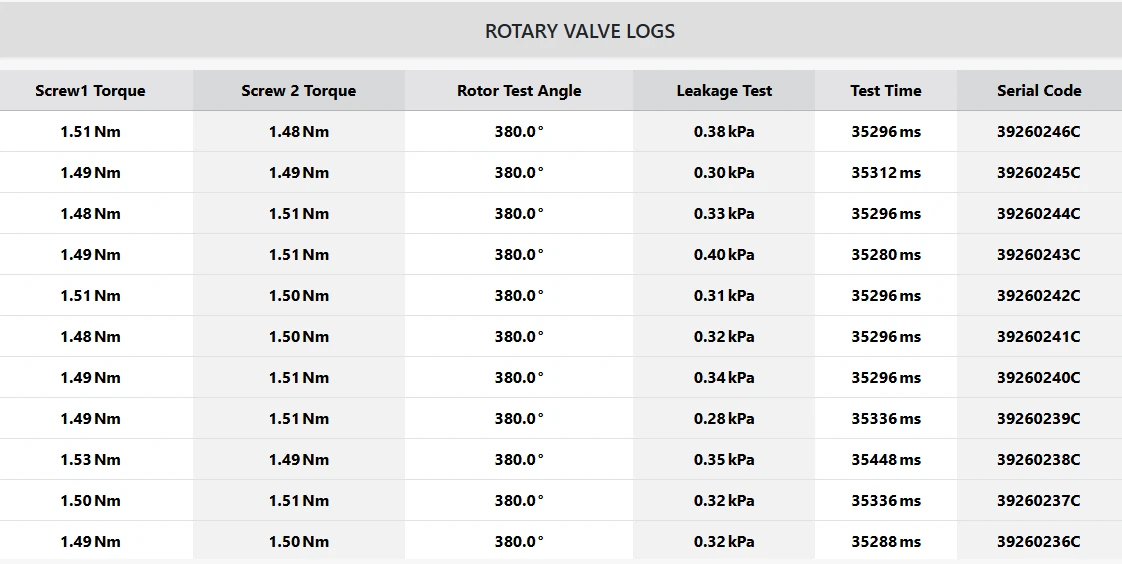
One line per valve
System Manager on the valve machine: what every station measured, for every valve, on one screen and on record.
Valve assembly and testing- Also in Technology
- Robotics · Measurement · Mobile Robotics
- All nine
- How we work: the nine capabilities and the loop they form
Show us the part on your screen
Send a photo of the part and tell us what the cell has to find, measure or record. We will tell you what IROVISION would see, and what it would not.
Talk to an engineer